
Machinery
Three questions decide the material: can it be machined, will it assemble accurately, and does it contaminate the product it touches. Food and pharma machinery adds a fourth — cleanability.
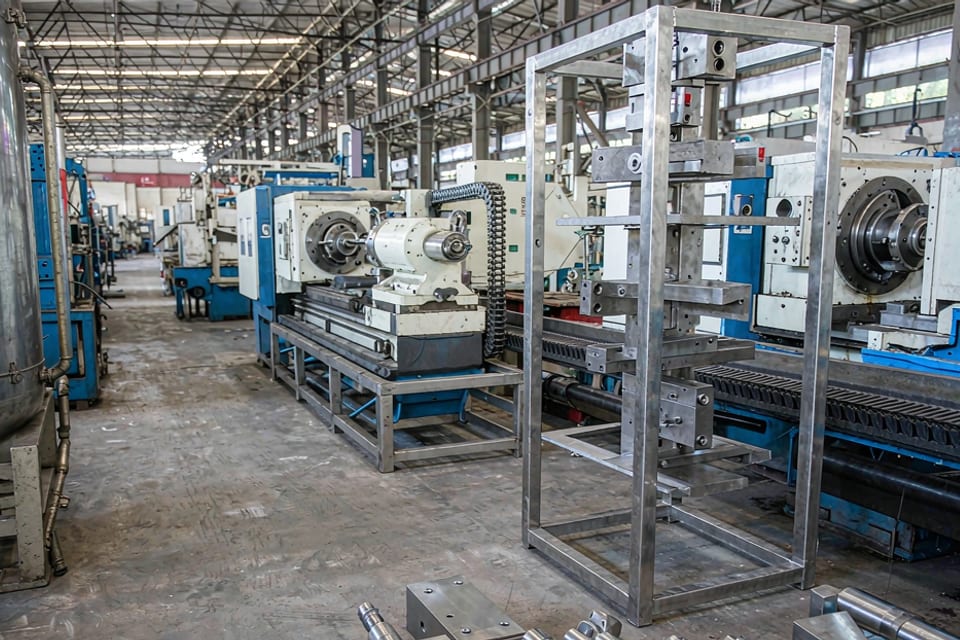
Typical parts and material selection
| Part | Grade | Surface / size | Watch out for |
|---|---|---|---|
| Frame / base | 304 | Plate 8–30 mm, 2B | Flatness, weld distortion |
| Hopper / conveyor trough | 304 / 316L | CR sheet 1–3 mm, 2B | Ground welds, no dead corners |
| Food contact part | 316L | 2B / Ra ≤ 0.8 μm | Cleanability, passivation |
| Shaft / roller | 304 / 316L | Bar / seamless tube | Machinability, straightness |
| Guard / cover | 304 / 430 | 0.8–2 mm, brushed | Fingerprint resistance |
Three real constraints in this industry
"Food grade" is a surface, not a grade
316L only guarantees chemistry. What decides cleanability is roughness and weld quality: Ra ≤ 0.8 μm on product-contact faces, full-penetration ground welds, and large radii at corners.
Tell us early if it is machined
Austenitic stainless work-hardens fast and 304 is harder to cut than 316L. For volume parts consider 303 (free-machining) or switch to laser cutting / investment casting to remove turning.
Weld distortion is harder than strength
Thin-wall hoppers bulge after welding. Use balanced sequence welding with fixtures, tack first then run the seam — settle this at drawing review, not on the shop floor.
Related products
Need a quote or technical support?
Send us the part, grade, size, quantity and destination port — we reply with FOB / CIF within 24 hours.